Friday, December 10, 2010

V-Portals from the Open World

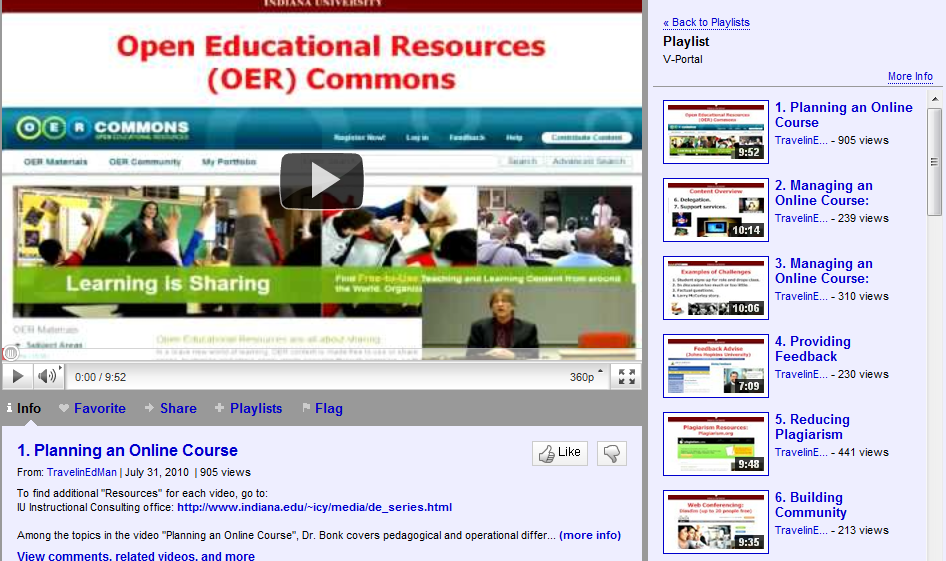
Curt Bonk, author of The World is Open, announced in his blog last week that he has designed and produced a series of 27 brief (7 to 10 minutes each) videos about teaching online. He's calling it the "V-Portal" for "Video Primers in an Online Repository for e-Teaching And Learning" and you can access the series at the V-Portal here. They're also conveniently available on YouTube here as a playlist. I recommend them for anyone interested in professional development, individual discovery, or introducing a topic related to online instruction to an audience or planning group.

Here's the topic list:
1. Planning an Online Course
2. Managing an Online Course: General
3. Managing an Online Course: Discussion Forums
4. Providing Feedback
5. Reducing Plagiarism
6. Building Community
7. Building Instructor and Social Presence
8. Online Relationships: Student-Student, Student-Instructor, Student-Practitioner, Student-Self
9. Fostering Online Collaboration/Teaming
10. Finding Quality Supplemental Materials
11. Blended Learning: General
12. Blended Learning: Implementation
13. Blended Learning: The Future
14. Online Writing and Reflection Activities
15. Online Visual Learning
16. Using Existing Online Video Resources
17. Webinars and Webcasts
18. Podcasting Uses and Applications
19. Wiki Uses and Applications
20. Blog Uses and Applications
21. Collaborative Tool Uses and Applications
22. Hands-On/Experiential Learning
23. Coordinating Online Project, Problem, and Product-Based Learning
24. Global Connections and Collaborations
25. Assessing Student Online Learning
26. Ending, Archiving, Updating, and Reusing an Online Course
27. Trends on the Horizon

Each video provides a good overview of its topic and suggestions for instructors considering using the relevant technology. For example, Topic 17 (Webinars and Webcasts) mentions most of the major players in the Web conferencing and lecture capture arena, with examples, and includes these suggestions for instructors:
  • Have an orientation/practice session before your first "live" Web conference with students
  • Check (at least 15-20 minutes early) to make your equipment works
  • Explain the purpose of the session/task
  • Schedule breaks for your students
  • Avoid talking for more than 15 or 20 minutes without pausing
  • Use polls or surveys to engage students
  • Archive the event for students who miss it
  • Review what you've covered at the end of the session
  • Follow up a synchronous experience with an asynchronous one (or vice versa)
  • Hang a "Do Not Disturb" sign outside your office door (and keep water handy)
  • Select a time that takes all students into account
  • Embed synchronous sessions where and when they best fit
  • Create an agenda for each session
  • Give students tips and guidelines for the Web conferencing technology
  • Be highly organized but flexible
  • Attend faculty development sessions on Web conferencing if possible
Good advice, and well presented! Thank you, Dr. Bonk.


Friday, December 3, 2010

The Future of Higher Education is Online. (Get Over It.)

"Those in higher education who continue hand-wringing over the relative merits of online learning and other technology-driven platforms will soon find themselves left in the dust of an up-and-coming generation of students who are seeking knowledge outside academe." - Jack Stripling, Inside Higher Ed

Last month, college leaders apparently came to that conclusion at the TIAA-CREF 2010 Higher Education Leadership Conference. Mary Spilde, President of Lane Community College in Oregon, said that today's students are "pretty bored with what we do." David Millron of the Bill & Melinda Gates Foundation suggested that "we are not far from the day when a student, finding unsatisfactory reviews of a faculty member on ratemyprofessors.com, will choose to take a class through open courseware online and then ask his home institution to assess him." Talk about the tail wagging the dog!

A recent special edition of the Chronicle Review was dedicated entirely to online learning. Marc Parry's article declares, "the classroom of the future features face-to-face, online, and hybrid learning. And the future is here." Salmon Khan of the Khan Academy says "YouTube U. Beats YouSnooze U." and passionately argues for a new paradigm to replace lectures and textbooks as they are traditionally employed. His not-for-profit and open-source-based academy has the support of the Bill & Melinda Gates Foundation. And Mark Milliron (also from the Gates Foundation) simply states, "Enough already." The "family feud" needs to stop so that we can teach today's students and maintain our relevance. The debate about which is better - online or face-to-face - no longer resonates. What's most obvious and disturbing is that our global competitors are doing a better job than we are at educating at-risk, low-income, minority, and part-time students. And they're doing this largely via online instruction and learning opportunities.

There are economic reasons to end the feud, aside from those related to unserved populations. At the Association of Public and Land-Grant Universities annual conference, Christopher Edley, dean of UC Berkeley's Law School, said "It's abundantly clear that the bricks-and-mortar model is unsustainable if we want to preserve our mission." The University of California projects a $4.7 billion budget gap over the next ten years. Edley maintains that 25,000 new students could be served online for $50 million, but would also generate $180 million for the system. His pilot program of online courses is designed to generate revenue the UC badly needs simply to survive. This practical acknowledgment is echoed in a report from the Legislative Analyst's Office, “Using Distance Education to Increase College Access and Efficiency,” which urges college administrators to increase college access by offering more online classes.

Wednesday, November 24, 2010

Thanks and Gratitude for Educational Heroes

"One looks back with appreciation to the brilliant teachers, but with gratitude to those who touched our human feelings. The curriculum is so much necessary raw material, but warmth is the vital element for the growing plant and for the soul." ~Carl Jung


"If a doctor, lawyer, or dentist had 40 people in his office at one time, all of whom had different needs, and some of whom didn't want to be there and were causing trouble, and the doctor, lawyer, or dentist, without assistance, had to treat them all with professional excellence for nine months, then he might have some conception of the classroom teacher's job." ~Donald D. Quinn


For you, I don't know why
But you, make it all clear

And you, wrap it up perfectly

For you, I'll do my best


You never taught me how to win,

But to be justified

You never told me what to do,

You just guided me through it


The paths were all laid,

But you let me run so free

You never carried me to the grass,

You let me swim the seas


For you, is why I am here today

But you, are half the reason

And you, let me make mistakes

So for you, I learn from them.


- Jenessa Irene Hopkins
Secret Gratitude

Friday, October 29, 2010

Who Owns My Lecture?

"If I write a book, it’s copyrighted in my name and so it’s my property, not UCLA’s. But my lectures aren’t copyrighted. Would they be if they were online? I don’t know.”  - Blake Allmendinger, quoted here.


A growing number of instructors are taking their face-to-face classes online in places like the Confer classroom. The lectures and sessions they capture (archive) are available, in many cases, free to anyone who browses the archives on our Web site. (Note: the instructor can decide - at any time - to make archives private.) While many of these lectures have limited value, some may have timeless value: the ideas shared are true today and will be just as true tomorrow and next year. CCC Confer is not unique in this trend: MIT Open Courseware offers nearly 2,000 courses, Apple's iTunes U has content from more than 600 universities, and YouTube EDU has thousands of captured lectures (including a channel from the California Community Colleges).

Technology makes it possible for instructors to distribute educational content to a worldwide audience, and to empower students to receive that content when and how they find it convenient. At the same time, some faculty members worry about the lack of control over distribution they may have once the content is made available on the Web. It can be shared with other students, posted elsewhere, perhaps even distorted if a talented (and highly motivated!) student takes the time to download, edit, and re-post the content.

As I write this blog, I'm listening to a stream of music MP3s playing on my computer's media player. Hundreds of artists originally performed this music in studios and arenas and other venues, probably without ever imagining or intending that I would use them as I am. There was a time when I had to buy albums from music stores, extract individual tunes and reformat them to compose a medley like this one, but that time is (thankfully) long gone. I think this is relevant.

We in higher education are not record labels. We don't have the same mission, but we now face similar issues. Professors have a right to payment for their work just as artists deserve to be paid for their work. At the same time, we're likely to see more "unbundling" of that work, more "mashing" of content in ways that are useful to individual students and divergent from the original intent of its delivery. Sites like DiplomaGuide and Khan Academy are early - and hardly imaginative - examples.

If you're worried about archiving your lectures because you want to protect intellectual property, I understand. I suggest using an opening screen that declares your rights to the content you're making available and the terms of use you deem acceptable. Naturally, you'll need to clear this with your employer, who may have other ideas about ownership and rights.

Meanwhile, I welcome your opinions and insights. Post them here or e-mail me.

Friday, October 22, 2010

Why We Love to Confer

"It has become commonplace to say that today's culture is marked by a ubiquitous computer technology. This has been true for some time... What is important to the educator-as-anthropologist, however, is that they exist as objects that people see, and start to accept, as part of the reality of everyday life. And at the same time that this massive penetration of the technology is taking place, there is a social movement afoot with great relevance for the politics of education... As an educational utopian I want to know what kind of computer culture can grow in communities where there is not already a rich technophilic soil. I want to know and I want to make it happen." - Seymour Papert, Mindstorms.

What makes instructors change their approach to instruction and adopt a new technology like Confer? What changes their mind, makes them learn new skills and expose themselves to the risk of embarrassment and failure?


Irene Palacios came to use CCC Confer because she needed a way to meet with her online students for office hours. She tried several other products first, but she was attracted to the quick, high-quality Confer interface, excellent support, and price (free). Irene says, "If you're not really good with technology, if you don't have a lot of time and a lot of money, and you want a quality product, Confer is the only way." Irene's students responded immediately, and it became so popular she found it hard to keep up with the demand.


Michael McKeever was attracted to CCC Confer because he had a need to expand his classroom outside the physical walls. His classroom had to be portable; he has taught his Santa Rosa Junior College students from the Phillipines, from Washington DC, from hotel rooms, and from wherever he travels. Confer gives Michael the freedom to attend events and do things he would not ordinarily do because he can bring his classroom with him wherever he goes.


Robin Rogers Cloud discovered that teaching art to online students actually became easier to do with Confer than did teaching art to students in a "normal" classroom. She believes that this tool has changed education for artists, and has revolutionized her classroom. She now has more time with her online students, and these students now actually prefer the online sessions to those she offers in the traditional classroom.


Donna Eyestone has learned something about teaching simply by using the Confer tools. She observes that students love this tool and show genuine interest in what they're doing and learning because of the "buzz" this virtual classroom helps to foster. By allowing her to give students a sense of who Donna is, Confer makes it easier to keep students engaged and excited. As Donna says, "every student has a front row seat."


Larry Green was never going to teach an online class before he encountered CCC Confer. He didn't believe that online classes allowed for the kind of spontaneity and interaction that he finds vital to the teaching of math. Now, Larry claims that teaching with Confer is actually better than face-to-face. One of the attractions for Larry is that no one tells him how he has to use it.

These five instructors independently discovered that Confer was ideal for their specific teaching requirements. While they may have been able to appreciate each others' observations about the relative merits of the virtual classroom, it seems likely from their stories that each of them needed to see specifically what they were able to see before they could be convinced that the ordeal of adopting a new technology was worth the effort. Michael, for example, might have appreciated Robin's enthusiasm for the visual immediacy of the whiteboard, but he would not have migrated to Confer without also seeing that his classroom could be portable. Now, each of them sees CCC Confer as a natural and normal part of teaching and their everyday life.

Seymour Papert envisioned this kind of penetration in the sixties, and he observed the social revolution that was taking place at the same time. Today, the ubiquity of the Web and pervasive social media set the stage for discoveries like these in classrooms and offices everywhere. We need a "rich technophilic soil" less than we need light to shed on the rich garden that's already growing around us.

Friday, October 8, 2010

Are You There? Presence in the Confer Classroom

"Some people, when they teach, are right there with the rest of us... others seem imprisoned in their own space, on the far side of an unbridgeable gulf. And of course there’s an abundance of positions in between... These differences in the degree of presence seem so obvious, so tangible that you would almost think there could be an instrument that would register them, not only from one teacher to another, but even, with a single teacher, from one session to another or even one moment to another." - Jerry Farber, "Teaching and Presence" in Pedagogy, Volume 8, Issue 2, Spring 2008, p. 215.

Garrison, Anderson, and Archer developed the COI (Communities of Inquiry) model, pictured in the graphic above, which posits that the learning experience is a function of social presence, teaching presence, and cognitive presence. Social presence is the quality that allows online participants to feel affectively connected with one another. Teaching presence - what Jerry Farber was discussing - is a sense of immediacy, openness, and spontaneity on the part of the instructor. Cognitive presence stems from the concepts of John Dewey and the need for integrated thought and action along with discourse and reflection.

How do you ensure teacher presence in the Confer classroom? One way is to ask questions designed to provoke your students and draw out their thoughts. Can you stimulate them into thinking about what you've taught them or even about how they feel about the content you've presented? And can you do this in a natural, spontaneous manner, even though you've done it several times before?

This latter part - making even a repeated, routine part of your lesson plan seem new and fresh - is the key. It isn't so much how well you know how to post a question to the whiteboard or present a poll to students. It isn't even a matter of making sure students are allowed to voice their questions. It's about BEING THERE when you teach: not giving in to what Farber calls "pedagogical mindlessness." Do your online students sense that you're actually present for them when you teach? Or are you spewing thoughts at them, going through the motions of listening to them or reading their chat responses, and not really paying attention to what's happening in the classroom right now?

Don't settle for less than full presence in your classroom. This is Farber's first point: that presence is most likely to occur if you insist on it. Make full teaching presence a standard by which you judge every online session with your students.

Watch what's happening. Farber also suggests that every student - every online participant - is doing something all the time. How are they engaging with you, individually and as a group?

Watch your energy. You're teaching at a particular moment in your life, and full presence requires all the energy you can muster at this time. What can you draw on that will give you the strength and stamina to focus fully on this moment and your time with your students?

It's certainly easier to hide behind a veneer of formality or a predetermined script. It's not only easier: it's safer, because being present makes you vulnerable to mistakes and criticisms. But it's what your students - and you as a teacher - deserve.

Friday, September 24, 2010

Control? Give Some Away to Keep It

"If everything seems under control, you're just not going fast enough." - Mario Andretti


You, the instructor, have total control of the online classroom - if you want it. You can keep your students quiet by taking away their voices. You can deny them chat privileges. You can even decide not to archive your meeting, thus forcing students to attend "live" in order to hear what you have to say. Everything they see, hear, and sense can be completely controlled by you - if, of course, your students decide to stay in your controlled classroom and ignore the text messages, e-mails, Facebook pokes, Tweets, and myriad other options available to them while you're teaching.

It's a little scary to give up control, but it may be necessary if you want to keep it. Sharing power with students is not an invitation to chaos: it's a recognition that students aren't really stupid, and they'll figure out what they can and can't get away with in most situations. At least one of their objectives in your course is to get a good grade, so they'll be looking for ways to "work your system" to accomplish that with the least effort. While you're lecturing in your controlled, question-free, interruptionless classroom, they'll be multi-tasking (or sleeping) without any way for you to check on their reactions or attention level. So who's really in control?

Most instructors in the Confer classroom have made a conscious decision to add more interaction - and give away some control - to their online sessions. And they've learned, by trial and error, how much control they're comfortable giving to students.


Marc Knobel discovered that there were lots of things going on at once when he taught math using Confer. He was talking, working with a graphics tablet, watching students as they arrived late to his classroom, monitoring the chat area for students' questions, and trying to teach. As he says in this clip, it took him a long time to learn to be comfortable with this type of confusion, and he settled on a few privileges - voice and chat - for his students. Giving away the whiteboard was not a viable option.


Larry Green, who also teaches math using Confer, tried giving whiteboard privileges to his students, and discovered "it was a free-for-all!" He had no whiteboard left once the students started drawing. Now, he reserves the whiteboard for himself while he's demonstrating problem-solving, and then gives the privilege to students one at a time. For example, one student draws a single point on the whiteboard graph, and Larry then gives the whiteboard tool to another student to draw a second point, and so on. This controlled sharing of power engages student participation without leaving the instructor completely powerless.


Robin Rogers Cloud, an art instructor, loves the participation she gets in her online Art Critique classes. She lets students talk, and says, "I can't get them to shut up now." In her face-to-face classes, they're often too shy to participate, but speaking up online seems to produce less inhibitions.

Students learn best when they actively participate in courses and take responsibility for their learning. In the Confer classroom, experimentation with power-sharing will show you what works best for you and your students, but here are some suggestions:
  • Start with small adjustments: give privileges sparingly and see what works
  • Ask questions often at first, and see how students prefer to respond (e.g., by chat, orally, whiteboard, or polling)
  • Use student feedback to guide discussion. If you ask a question, do something with the answers you get.
  • Create an assignment that allows students to tell you what they like best and least about the Confer classroom and their use of it. (And do something about what you learn from their answers.)
Get Twitter Fan Box Widget