Showing posts with label online teaching. Show all posts

Friday, May 2, 2014

Marshall McLuhan and Web Conferencing: What Message Is Our Medium?

I've just read a fascinating chapter by Mark A. McCutcheon which reflects on Web conferencing, Marshall McLuhan's thinking, and intellectual property issues. The print version appears in McLuhan's Global Village Today: Transatlantic Perspectives (Pickering and Chatto, 2014, ISBN-13:9781848934610) and a "pre-copyedited, pre-print version" is available here. The author covers more than I can describe here (and does a better job than I can), but I'd like to explore a few points specifically related to the Web conferencing medium.

McCutcheon was asked to present a paper at a conference which, as it turned out, he could not physically attend. Instead, he used Web conferencing to present his paper. But what does that mean, he asks? "I was neither present at the event, nor presenting a paper, as denoted by academic tradition, so much as orchestrating an audio-visual 'presentation,' at once a performance and a recording" (emphasis added). He presented "a digital slideshow, video images of my talking head and of the room of delegates..., and my microphoned voice, as I spoke the text of my paper." The session was recorded and can be "called up, replayed and paused, and distributed as a link with a password."

Web conferencing, says McCutcheon, "blurs the lines between performance and recording, between presence and representation." He goes on to describe a "dubject" created by this kind of technology, "assembled through technologies of mechanical reproduction, and distributed through networks of electronic distribution that blur the boundaries between ... consumer and commodity, the organic self and technological others...." We who use Web conferencing and similar technologies to reach distant audiences and/or future audiences are using "dubjection": "a technological doubling and spacing of the self."

He describes the spacing vividly:

On the day of the proceedings, I wasn't at Marburg, or at AU... If the conjunction at connotes a sense of place, of position - a humanistic, common-sense expression of live, embodied presence - then in that sense, I was somewhere, of course: I was at a neighbour's house. But that place became neither here nor there, so to speak, for the duration of my attendance at the conference. Would it be more precise to say that, at that time, I was "@" a number of spaces at the same time?... My image and voice projected into the Marburg town hall, racing unplumbed lengths of cable and unknown airborne frequencies, translated into strings of ones and zeroes as dense and complex as protein chains. Routed and rerouted through data centres and ISP addresses across the Atlantic (and quite possibly elsewhere), my dubjected presence traversed any number of relays and channels in the global IT network, less a village, certainly, than a vast electric ocean.
 All of us who have practiced Web conferencing are familiar with this disconnect. We're "here" and "there" at the same time, and our audience is "there" but we want them to be "here" while we're communicating with them. We want to see them and gauge their reactions, inspire them, motivate them, connect with them. The technology allows us to do some of that - more than we expected, in many cases - but it can't (yet) hide the "dubjection" effect. McLuhan said once that "media are a means of extending and enlarging our organic sense lives into the environment." That's why we confer (Confer) through Web conferencing.

The medium (Web conferencing) may well be the message. McLuhan proclaimed famously that "it is the medium that shapes and controls the scale and form of human association and action" (p. 9) and that "the 'message' of any medium or technology is the change of scale or pace or pattern that it introduces into human affairs" (p. 8). To ignore the change of scale, pace, and pattern that the virtual classroom engenders is to disconnect with the experience and the audience(s) we're trying to address. This evolving medium has the capacity to enrich our perceptions, insights, connections, and understanding of one another, provided we exploit its potential and help students and audiences to adapt to it.

Friday, March 7, 2014

Sail Into Online Student Success: Come to San Diego This June!

We've finalized the program for the 2014 Online Teaching Conference and looks like a terrific lineup! If you're an online educator, you spend a lot of time alone with your computer and your problems. At OTC, you're not alone! You can get critical insights directly from your colleagues, share your experiences, learn the latest strategies, and become a part of our wonderful community of online professionals. Join us June 20 and 21 for a comprehensive exploration of online teaching and learning. Get ready for two interactive days of learning that will prepare you to lead your institution with new ideas to power up online student success.

The OTC team has put together a top-notch program of sessions - presented by real online education professionals. Join us in San Diego for a unique professional development and networking event with opportunities to learn from distance education leaders about online teaching techniques and tools that will improve your bottom line and help your students fulfill their educational goals.


Friday, October 11, 2013

Ten Ways Web Conferencing Works in Education

I came across Beth Gallob's slideshow (below) earlier this week and was inspired to elaborate on it with our experiences at CCC Confer. We are always discovering new ways to use this great tool by watching and hearing from our users - instructors, administrators, trainers, even students. These ten suggestions are the "easy finds" in the great barrel of options Web conferencing provides. Share your own!


Top 10 Ways to Use Blackboard Collaborate from Beth Gallob

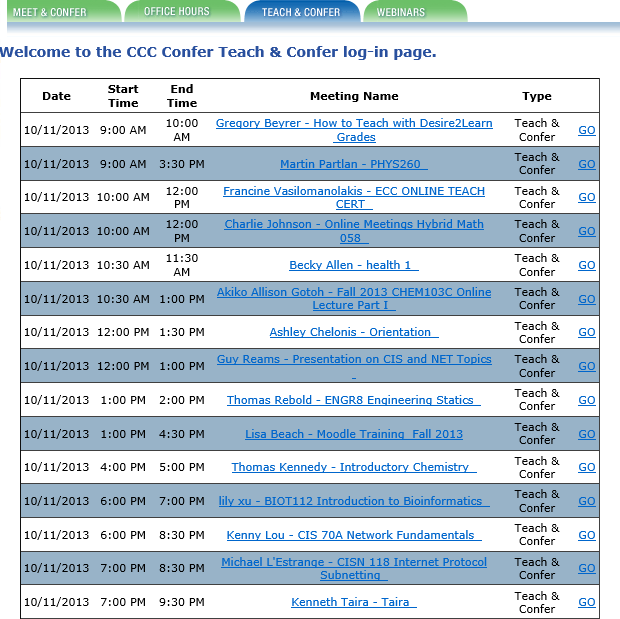
  1.  Live Instruction. In the CCCs, we call this "Teach and Confer" and literally hundreds of instructors use this tool every week to deliver live online instruction to students throughout the state (and, sometimes, the world). Classes are scheduled and links posted either within the college's Learning Course Management System or on the Confer Web site (see the schedule I captured from today's (October 11 list). As with Beth's case study example, we've had several instructors and researchers report on the effectiveness of this synchronous online instruction in reducing attrition, improving student success, and providing an effective means for students who might not otherwise be able to complete their educational goals to attend college and get their degrees. See, for example, Research on Online Spanish Classes, Case Study of Online vs. On-Campus, Grades and Attendance at Online Lectures, and Almost 95 Percent Retention.
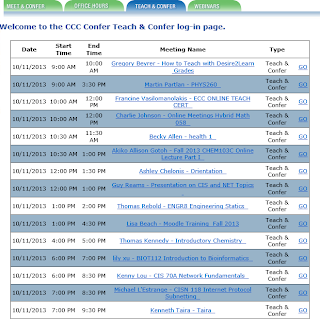
2. Meetings. With 112 colleges spread across the state of California, the California Community Colleges is a large geographical system that requires thousands of meetings every week to coordinate activities, check on progress, communicate goals, convene groups and subgroups, and simply operate as a system.Travel costs for these thousands of meetings would be prohibitive, to say nothing of the expenses incurred for meeting space, food and beverage, A/V materials and other incidentals. I've added another screen shot of some of today's (10/11) meetings, which are not atypical: a group of math instructors, IT meetings, librarian meetings, counselor training, various committees, a work group on data governance, online educators from a single college, department meetings, several task forces, student organizations, and many more. There's no question that millions of dollars every year are saved in the CCCs because these and hundreds of other groups elect to meet online instead of traveling to campus, other campuses, or to hotels or office buildings to accomplish the same goals: collaborate and get work done.
3. Recorded Content. Students who miss class or who need to review lectures or class sessions have it easy in our system if instructors record their sessions with CCC Confer. Archived sessions are converted to MP4 format and posted to the system's YouTube channel and to 3C Media Solutions, where they can be viewed, added to playlists, embedded into syllabi or lesson plans, and even downloaded. Where captioning has been requested, captions are included and can be viewed from any device. To see how recorded lectures can be used to help students and instructors, see Using Confer to Extend Face-to-Face Classes, Archives for Students Who Miss Class, Face-to-Face Students Love Archives, Confer for Lecture Capture and Video Lectures, Archives Serve Diverse Learning Styles, or Using an Archive to Extend Class Time.
4. Online Conference. Not everyone can attend every conference for a variety of reasons. Budgets are short. Other duties conflict with the time and date of the conference. Space is restricted or there may be other physical limitations. With Confer, it's easy to capture, preserve, and distribute conference presentations to both participants and to non-participants who are nonetheless interested in the subject matter. Perhaps our best known conference of the year is the Online Teaching Conference, which captures roughly a third of its presentations this way and makes them available in real time to online attendees and as recorded videos for everyone else. We've done this for several other system-wide conferences with great success, and many organizations within the system have been able to offer online conferences using similar methods.
5. Mobile Web Conferencing. Now that Blackboard Collaborate has apps for both iOS and Android devices, attendance and participation in online classes and meetings has been extended to the mobile users in our system, making it even easier to connect while on the go.
6. Virtual Office Hours. Instructors need to meet with students, and these meetings often need to occur outside of class sessions as student are engaged in their studies, assignments, or research and need guidance or feedback.Some campuses and institutions require that these office hours be held in offices that
are physically located on campus, but those policies are changing as the realization grows that travel to campus is difficult and unnecessary, and that the virtual office is often better-equipped than the average faculty member's office (to say nothing of the office-sharing or office-less adjunct faculty member). The screen at left shows my capture of today's Office Hours schedule. As I looked these up, I was surprised to see so many on a Friday, but many also on Saturday and Sunday this weekend. This points out another great advantage to virtual office hours: since they don't occur on a campus, no other staff (custodians, campus security, etc.) are required to work so that the instructor can meet with his or her students. This makes it a more flexible and affordable service for the institution.
7. Student / Parent Orientation. As online education gains in popularity, the requirement that students enrolling in an institution physically attend an orientation session is becoming increasingly unpopular and suspect. Providing an online orientation for online students makes sense, as does the popular practice in our colleges to use Confer to orient students to online classes, the virtual classroom, the library resources available online, the availability of online tutors and other support services, and to their fellow classmates. So many students become acquainted with their college experience by meeting online via Confer, and it's also true that some of them graduate and attend commencement ceremonies online via Confer!
8. Remote Guest (Speaker / Virtual Field Trip). This is another natural implementation, and we've seen it used in very creative ways. One music instructor attended an opera and allowed her class to virtually attend from her computer, including an after-performance interview with the performers. Another instructor taught her northern California Spanish classes from Costa Rica, where she introduced locals and gave virtual tours from overseas. We've seen instructors from different institutions take turns guest lecturing in each others' classes, and conduct inter-institutional debates and presentations by students separated by physical miles but connected virtually by the Confer classroom.
9. Professional Development. The CCCs have practiced online professional development for years, and it is built into our infrastructure. Nearly every organization that serves the system uses Confer to
train employees and colleagues, and the fact that training sessions are recorded allows for new employees or transfers to catch up with their colleagues quickly by viewing the sessions online. A glance at today's and future Webinars shows the diversity of this popular service: a presentation on revitalizing education, training on online research methods, a session related to legislated adult education planning requirements, training on applications to four-year institutions, an orientation to the California College Guidance Initiative, Open Educational Resource training, a library training related to integrated library systems, a Webinar on how to flip the classroom, training on Board policy for course pre-requisites, software training for specific educational applications, and sexual harassment training. The money, time, and resources saved by having these trainings online instead of at physical locations is immeasruable.
10. Virtual Help Desk. By providing an easy way to connect with experts or support people online, colleges can better support students, especially (but not necessarily exclusively) online students. Counselors, librarians, and tutors have been especially attracted to this use of CCC Confer. For a sample playlist of testimonials from some of these professionals, follow this link.

Thanks to Beth for creating the list and to the many thousands of Confer users who've shown us how to use this tool to support education. Please feel free to share your own ways to make Web conferencing work.


Friday, August 9, 2013

Online Teaching 2013: The State of the Art

The 2013 Online Teaching Conference in Long Beach, California encompassed myriad topics that reflect the major trends and concerns of the profession: MOOCs, legislation related to distance education and open educational resources, YouTube, the rapid changes in the educational environment, hybrid options and design, collaboration, faculty training, social media, online student services, digital textbooks, tutoring, disruption, and innovation. Thanks to the great work of the OTC professionals, here's a sample of the recorded sessions.


Friday, August 2, 2013

Be There Now (or Later): How to Be Present When Your Students are Somewhere (or Somewhen) Else

In 1971, Ram Dass published Be Here Now, a life-changing book for many of the Boomer generation. The book emphasized spiritual truths and the admonition to be present at the only time that matters - now - and in the only place that matters - here. With quotes like "the next message you need is always right where you are," it brought many readers to an awakening based on the present moment.

Teachers in the virtual classroom often have a difficult time with the concept of "presence" and "here and now." They miss the eye contact with students that the traditional classroom provides, making it difficult to hold the audiences' attention or even to know when they are holding it. Non-verbal signals (facial expressions, body language, hand gestures) are also missing online. Students who wish to can get up and walk around, turn their backs on the instructor, switch screens, feed babies, etc.: there is little physical control granted to the instructor over the virtual classroom. Distractions - barking dogs, incoming text messages, e-mail, Facebook prompts, etc. - are difficult to control and have the potential to destroy instructor presence. We've all got horror (or humor) stories about that: one that recently appeared in The Chronicle's Wired Campus spoke of "barking dogs, wailing babies, and a naked spouse" as intruders in the virtual classroom.

The potential for disconnectedness or distraction is so great that virtual classroom instructors have to be proactive, just as the readers of Ram Dass's book were urged to "wake up" and "be here now." They must pay attention to what they're saying, how often they pause to ask questions and wait for answers, and how they recognize opportunities to solicit feedback and participation. They regularly check the class roster and call on students to contribute thoughts or materials. They know that injecting humor or surprise is an effective method for breaking the ice and getting everyone's attention. They find ways to personalize their presentation, often by using the Web cam judiciously to show themselves and/or their environment or by inserting personal pictures (of themselves, their garden, a pet) onto slides or whiteboards.

Where synchronous collaboration is possible (i.e., where you have an online audience now), it should be encouraged and planned for. I like to make my students believe that they can be called on anytime to do something - and then prove it by calling on them randomly and often. If more than three minutes go by without my pausing to engage my online audience, I'm in danger of losing both them and myself in the lecture, not the present moment. I like to insert a PAUSE slide about every 10 slides in my presentation to ensure that I use it and "wake up" to my audience. The chat back-channel is a great way to reinforce presence and engagement, as long as you pay attention to it and encourage student participation.

Vicki Davis cites 12 healthy habits to grow your online presence in her Cool Cat Teacher Blog:
  1. Share.
  2. Respond.
  3. Comment.
  4. Link Generously.
  5. Read (or Listen) Prolifically.
  6. Distribute Yourself.
  7. Beware of Flattery.
  8. Live Life Online and Off-line.
  9. Latch Key Your Legacy.
  10. Laugh (a lot).
  11. Take Every Presentation Seriously.
  12. Expect Criticism.
Be there!

Friday, July 26, 2013

Lighten Up Online (Seriously!): The Value of Humor in the Virtual Classroom

"A joke is a very serious thing." - Winston Churchill

In Carla Meskill's forthcoming book on Online Teaching and Learning, N. Anthony has contributed a chapter entitled, "Perceptions of Humour in Oral Synchronous Online Environments." Anthony interviewed and surveyed students and teachers using the Wimba classroom specifically to determine the role of humor in this synchronous online environment. Here are some of the students' comments:
  • "It helped with the anxiety levels. The times we had humor, it did kind of lighten the mood and took the pressure off...."
  • "It helps me to relax and not feel pressured."
  • "It makes it more fun and makes it more ok to try and make a mistake than being afraid to speak...."
  • "Making it funny helps people feel less insecure about messing up."
  • "I believe that teacher-initiated humor relaxes the classroom and leaves us all more willing to participate because we aren't afraid to mess up because there is a portrayed sense of light-heartedness."
  • "It just makes it easier to feel relaxed and speaking in conversation is less intimidating." 
  • "It's easier to remember something that is funny than something that is boring... Words are remembered better when presented in humorous situations."
  • "Often humor makes the content more memorable and therefore helps to learn it faster and better."
  • "I tend to remember things more easily if I have a phrase to associate them with, and humorous phrases are particularly memorable."
Other researchers have noted the beneficial role of humor - both from teachers and from students - in the online classroom. Mirjam Hauck and Regine Hampel investigated the factors in the virtual classroom that facilitated interaction (with students and with instructors) and observed, "making humorous comments or observations to improve the interaction with individual partners and the group as a whole was also identified by several students as a motivating factor." They describe a particular use of humor by a student who did so because he perceived that "some of his peers still felt uncomfortable in the synchronous online environment and were therefore exposed to techno-stress and cognitive overload."

Michael Eskey notes that "humor, whether in the form of jokes, riddles, puns, funny stories, humorous comments or other humorous items, builds a bond between the instructor and students; bridging the student-teacher gap by allowing students to view the instructor as more approachable." How you introduce and use humor will depend on your teaching style, your pedagogical objectives, and your comfort with the tools available in the online classroom, but there is a growing body of evidence that students learn better when they are allowed to "loosen up" online and enjoy themselves and one another.

In the Confer classroom, instructors will inevitably be doing some things by "trial and error": the technology changes, for one thing. Successful instructors demonstrate a fearless attitude and don't mind making public mistakes in the process: it's probably the best way to encourage experimentation and exploration on the part of students. By letting your audience (students) "in on the joke" while you try to figure out how a new tool works, you're allowing them to participate (naturally, you won't allow your experiment to last so long that it interferes with instructional time or time on task).

Have fun!

Friday, June 28, 2013

Alone (or All One) Together Online: What Keeps Us Together in the Virtual Classroom

The constructivists maintain that social interaction leads to knowledge construction, higher order learning, and greater student success rates (i.e., achievement and completion). Students have to socially network in order for the neural network to do its thing and make connections between concepts and ideas. Sherry Turkle's wonderfully insightful book Alone Together is about, as she says, "how we are changed as technology offers us substitutes for connecting with each other face-to-face." The danger may be that if we use substitute (artificial) networking online, we may produce artificial learning or hamper the connections needed to enable real comprehension and mastery.

How do we build a community of learners from strangers who only meet online? Etienne Wenger prescribes course design elements that encourage interaction and reification (making things seem real). The use of real-time voice and video is one method the Confer instructor uses to deliver to students a sense of a real-time, articulate, caring, human. As Walsh et. al. reported in their study of Web conferencing learning communities, students may struggle with video and audio, but they prefer it to the alternative. "I think seeing someone on screen during the tutorial can keep you interested and makes the tutorial feel more interactive," says a Humanities student. Another student says, "I think the tutors who use this need to try and make it as interactive as possible ... [and to] input their own thoughts and ideas." Asked how the instructors could improve their use of the Web conferencing technology, students suggested:
  • "Find ways to ensure students participate in the live sessions"
  • "Develop and encourage methods for collaboration between students"
  • "Remember to use students' names to help make it a more personal experience"
McBrien and Jones cite similar observations from the students in their synchronous online learning study. "Talking through the microphone really helped me connect my thoughts, knowing that I could only express myself verbally. It also made me feel more in control of how I communicated my ideas because a large group of people weren't staring at me..." "Voting was great - great to see what everyone else in class felt - you don't always get that feedback." Their students reported these negatives in the virtual classroom:
  • Missing friends
  • Lack of support when presenting
  • Missing non-verbal gestures
One student observed that the class "needs to be planned more carefully and maybe tried the first session with all of the students in the classroom, not home."


We may be years away from taking these general suggestions and translating them into practical course design for the synchronous virtual classroom. As Mia Lobel et. al.  observe: "There is virtually no data describing how existing successful pedagogies, which are predicated on real-time interactive immediacy and skill practice, could be adapted to online learning environments. Much discussion and exploration is needed concerning the delivery of human relations skills online, when the pedagogy is based on group interaction, specifically active experiencing, concrete observation, abstract conceptualization and active practice and the content design is predicated on theories of group development, and observational and facilitation skills which necessitate participation and interaction."


Friday, June 7, 2013

Online Teaching: What the Experts Say

The Online Teaching Conference is days away, and there will be lots of exciting and informative presentations in Long Beach June 19-21. But why wait? Some of the presenters have already pre-recorded their presentations. Take a look - and make sure you register for the conference so you don't miss more!
You're Teaching a Course Online! Did You Do It Right? In this session Mauricio Cadavid discusses strategies for student success, engagement, and a positive learning experience. The audience will learn about developing rapport with their online students, as well as acquire a list of web-tools that can be used as effective design of class activities and participation.


The Importance of the Application of Critical Thinking in the Online Classroom.
Michael Eskey addresses teaching critical thinking skills to our online students. Research indicates that academics and students have differing perceptions of what happens in university classrooms, particularly in regard to higher order thinking, in particular, critical thinking. Higher education is challenged with encouraging students to pursue higher-order thinking and often fall short according to industry standards. The current research that will be discussed is directed at responses from full-time and adjunct faculty teaching either face-to-face or online mainly in the disciplines of criminal justice and political science to assess their views and application of teaching critical skills. The findings are applicable to all disciplines and emphasize the importance of specific instructor training to apply to the classroom in this area.


Yo Ho Blackboard Inline Grading For Me!
Eric Wilson explains that Blackboard recently updated the way you can grade Assignments and Discussions! With the new Inline Grading System, this recorded workshop will show you how to create Assignment and Discussions and how to grade both with the new inline system and paperless. Eric reviews the built in rubric system as well. It is so easy and can literally make grading painless.


Recruiting, Training, Maintaining, and Retaining Online Adjunct Instructors
Dr. Henry Roehrich with Dr. Michael Eskey explain that the development of online adjunct instructors requires a professional adult learning approach that incorporates a facilitation training program, mentoring process and instructor informational resources. The presentation outlines and discusses how this process can be effective and tailored to the needs of institutions in higher education. This will include the required online adjunct recruiting process, required training, online resources, professional development opportunities, the formal / informal mentoring process, required and optional refresher training. Additionally, there is a discussion of online adjunct and online student perceptions of instructional needs and requirements.


Does a Face Make a Difference? Comparing Synchronous Online Education with Other Instructional Methods at California Community Colleges and the Impact on Student Retention Rates
Claudia Tornsaufer
The main focus of this study was to investigate whether there is a difference in mean institutional retention rates among California community college students by the following institutional characteristics: 1) instructional method (on-campus, asynchronous and synchronous online courses); 2) ethnicity; gender; and age groups. The study’s findings on student outcomes will shed light on the impact of increased online student-teacher, student-student and student-content interaction in synchronous online courses and how it compares to the interaction on on-campus and asynchronous courses.


Friday, December 7, 2012

Best Practices for Synchronous Online Instruction: An Update


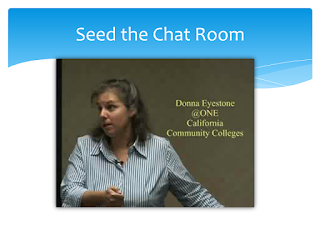
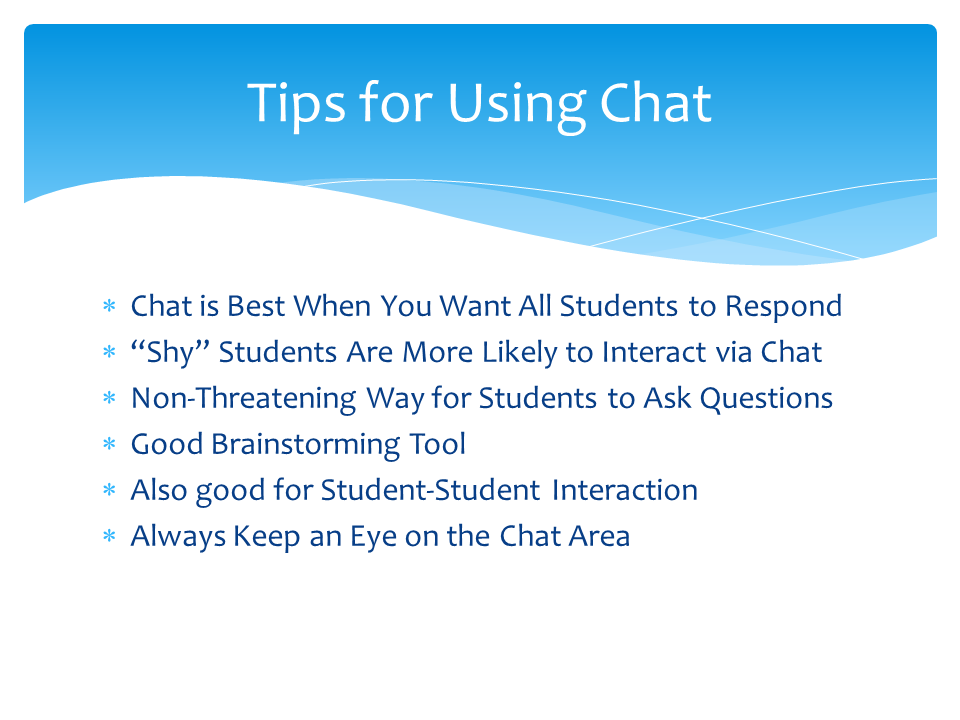
Slideshare recently contacted me to say that my presentation on best practices for synchronous e-learning had attracted more than 1,000 viewers. I know they meant well, but - instead of making me happy - I felt terrible! The presentation used a ton of embedded videos to make its points, and when I sent the slides to the site, none of the videos were included.

So here's my correction for those who may still be interested: the slides and the videos, together again. (To view the videos, click on the relevant images.)


Click to view


Click to view

Click to view

Click to view


Get Twitter Fan Box Widget